
Bajorat Media
Content audit for websites: review content and improve it with purpose
A content audit shows which website content works, which pages should be improved and where pages can be merged.

Many company websites grow over years: new service pages, old blog posts, campaign landing pages, press areas, download pages and individual pieces of content from previous relaunches. At some point it becomes unclear which pages actually help, which ones merely exist and which ones slow down visibility or user guidance. A content audit for websites brings order into this situation: content is collected, evaluated and translated into clear decisions.
The value is not limited to better rankings. A content audit also helps make a website easier to understand, improve internal links, remove outdated statements and focus editorial work on the pages that matter to customers and search engines.
When a content audit for websites is useful
A content audit is useful whenever a website no longer feels like a clear system. Typical triggers include a planned relaunch, declining visibility, many old pages, a new service offering or the question why visitors arrive but do not make inquiries.
The audit is especially valuable before a website relaunch. Instead of moving everything into a new design, the team decides which content should stay, which pages need updates and which topics should be merged. A content audit is also a strong starting point for ongoing search engine optimization because it connects technology, search intent and editorial quality.
A common mistake is evaluating content only by page views. A page with little traffic can still be important for a very specific inquiry. At the same time, an old article may attract many visitors but create little trust, few leads or limited subject relevance. That is why a content audit needs several perspectives.
Which data belongs in the content inventory
The first step is a complete inventory. All relevant URLs are collected from the sitemap, CMS, crawling tools, analytics, Search Console and, if needed, old redirect lists. The goal is not a perfect spreadsheet, but a reliable working basis.
For each URL, at least the following information should be recorded:
- Page type: service page, blog post, FAQ, case study, landing page or archive.
- Main topic and assumed search intent.
- Current clicks, impressions and important search queries.
- Internal links, incoming links and important navigation placements.
- Freshness, subject quality and editorial state.
- Conversion proximity: inquiry, download, contact, consultation or information need.
- Technical issues such as 404 errors, redirect chains or incorrect canonicals.
- Responsibility for review, editing and approval.
The Google Search Central documentation on helpful content emphasizes that content should be useful, reliable and people-first. That is also the central audit question: does this page help a specific audience with a specific task?
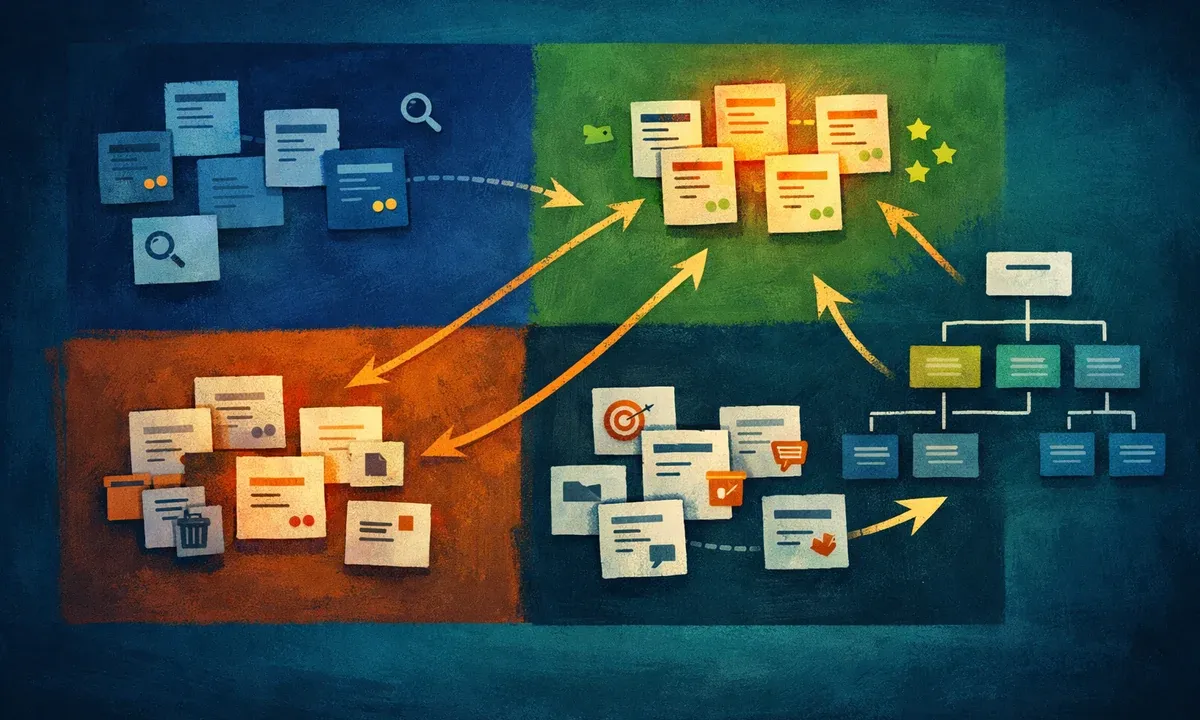
Evaluating content: keep, improve, merge or remove
After the inventory comes the evaluation. The goal is not to delete as many pages as possible. Good decisions are made by combining data, subject expertise and the user perspective.
| Decision | When it fits | Typical action |
|---|---|---|
| Keep | The page is current, helpful and strategically relevant. | Small updates, check internal links. |
| Improve | The topic matters, but the content is below its potential. | Improve structure, snippet, depth, examples and links. |
| Merge | Several pages cover almost the same topic. | Strengthen the best page and add suitable redirects. |
| Reposition | The content is good, but sits in the wrong page type. | Move it into blog, FAQ, service page or landing page logic. |
| Remove | The content is outdated, irrelevant or has no replacement value. | Check deindexing, deletion or 301 redirect. |
For similar topics, this matrix helps prevent keyword cannibalization. If three pages serve the same search intent, they often compete with each other. A stronger target page with clear internal links and suitable supporting content is usually better.
When URLs change or old pages are removed, the technical implementation has to be right. In its documentation on redirects and Google Search, Google explains that permanent redirects can be a strong signal for the canonical target. For the audit, this means: content decisions and technical migration logic belong together.
Matching search intent and page type
A good content audit does not only check whether a text is “SEO optimized”. What matters is whether the page fits the user’s intent. Someone looking for an agency needs different information than someone trying to understand a term, compare prices or solve a technical issue.
Typical patterns:
- Service pages answer whether a provider can solve the right problem.
- Guide articles explain a topic, a process or a decision.
- FAQ pages answer clearly defined questions.
- Case studies show experience, context and results.
- Landing pages bundle a specific offer for a campaign or audience.
When these roles blur, weak pages emerge. A blog post tries to sell, a service page becomes a text collection or an FAQ page tries to replace necessary consultation. For SEO texts and copywriting, wording is therefore not the only relevant factor. The right place within the website system matters just as much.
Internal linking as part of the audit
Many content audits focus too strongly on individual URLs. Visibility often emerges from relationships: which page strengthens which other page? Which guide articles lead to relevant services? Which older posts have useful signals but link to outdated targets?
Useful internal linking serves three purposes. First, it helps visitors move from information need to decision. Second, it makes topical relationships easier for search engines to understand. Third, it prevents valuable content from disappearing deep in the archive.
Do not only check whether links work technically. Also check whether they make editorial sense. An article about website strategy can point to Webdesign & Conception. A post about search intent fits Search Engine Optimization. A process article can link to Automation & AI when workflows, evaluation or editorial review processes should be supported.
Prioritizing instead of touching everything at once
After a content audit, the task list is often long. That list is not useful unless it is prioritized. For SMEs, the key question is which measures can create impact first and which ones can wait.
A pragmatic order:
- Fix critical errors: important pages that are unreachable, incorrect redirects, duplicate indexing, technical blockers.
- Strengthen strategic service pages: offers that are commercially important and have search potential.
- Improve visible content with potential: pages with impressions but weak click-through rate or low conversion.
- Merge duplicate topics: consolidate similar articles and old landing pages.
- Improve internal links: connect relevant guides, services, FAQ pages and case studies.
- Derive an editorial plan: plan missing topics deliberately instead of publishing new articles at random.
The most important point: an audit is only complete when analysis becomes concrete decisions, responsibilities and an implementation order.
What should be measured after implementation
After the update, patience and measurement are needed. Not every change has an immediate effect, and not every positive development comes from one measure alone. Still, useful indicators can be monitored.
Important metrics include clicks and impressions in Search Console, rankings for key search intents, organic entry pages, internal click paths, form starts, scroll depth on long guide pages and technical indexing reports. For relaunches, old URLs, redirects and important page types should be actively checked after launch. Google’s documentation on crawling and indexing is a useful technical basis for that work.
A content audit is therefore not a one-time cleanup, but a working model for better website maintenance. Companies gain a clearer view of which content performs a real task, where quality is missing and which pages should be connected more strongly.
Conclusion: a content audit makes website work more decisive
A content audit for websites is especially helpful when a site has grown over time, become confusing or is heading into a relaunch. It connects data with editorial judgment and prevents decisions from being based only on gut feeling, design preferences or old site structures.
For companies, that means fewer unnecessary pages, better priorities, clearer internal links and content that answers user questions more precisely. That is what makes a website more search-friendly and easier to understand for the people who ultimately need to make a decision.