
Bajorat Media
What are WCAG (Web Content Accessibility Guidelines)?
WCAG are international guidelines for accessible web content. This article explains principles, conformance levels and practical relevance.
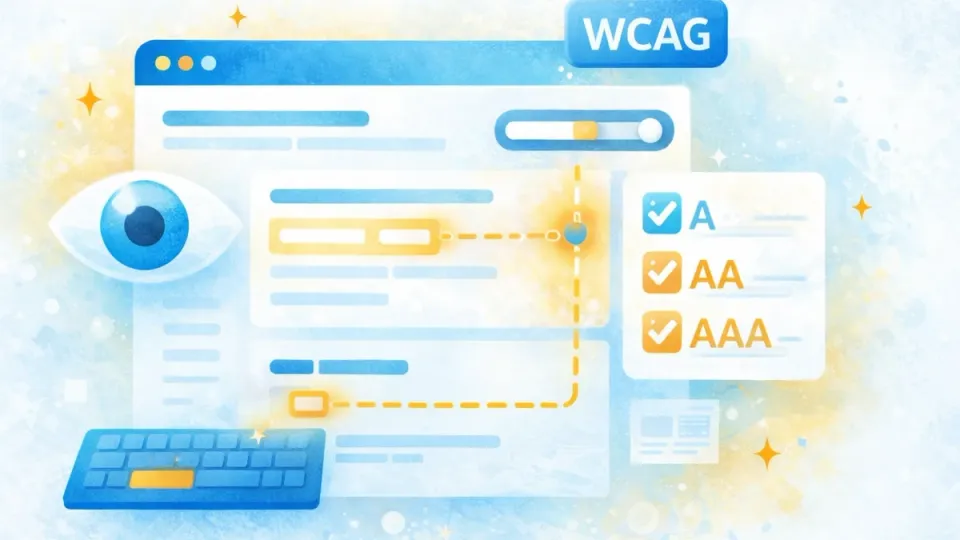
The WCAG (Web Content Accessibility Guidelines) are international W3C guidelines that describe how web content can be made accessible. They serve as a professional basis for many technical, organizational and legal requirements for accessible websites.
Which principles are behind WCAG?
WCAG is built around four principles, often called POUR: perceivable, operable, understandable and robust. Content must be designed so people can perceive it, operate it, understand interface and language, and use it reliably with assistive technologies.
This leads to concrete requirements such as sufficient color contrast, keyboard accessibility, clear error messages, semantic HTML, alternative text and robust structure for screen readers.
The principles help avoid treating accessibility as a collection of isolated tricks. A website can have good contrast and still be difficult to operate. Or it can look clear visually but be poorly structured for screen readers. WCAG connects these layers.
What do A, AA and AAA mean?
WCAG defines three conformance levels. Level A describes basic requirements. AA is the most important target level in practice for many websites and legal requirements. AAA is significantly stricter and not fully realistic for every website.
For companies, AA is especially relevant because many web accessibility requirements are oriented around it. This also applies in the context of the BFSG, the German Accessibility Strengthening Act, although concrete obligations always need to be assessed individually.
AAA is not a general standard for every website. Some criteria are useful in specific contexts, while others cannot be fully achieved for all types of content. Projects therefore usually define a realistic target level and validate it through testing.
Which version is current?
WCAG 2.2 was published as a W3C Recommendation on October 5, 2023. It extends WCAG 2.1 with additional criteria for operability, focus visibility and help with input. Projects should therefore clarify which version is the professional and legal target.
The official specification is the WCAG 2.2 W3C Recommendation. Knowing the guideline is not enough, however. It has to be translated into design, content, frontend development, components and testing.
Why are WCAG important in web projects?
Accessibility improves usability for many people: people with visual impairments, motor limitations, cognitive load, temporary restrictions or difficult usage situations. This benefits not only people with disabilities, but also mobile users, older audiences and teams that need digital processes to work efficiently.
Solid implementation of accessibility starts early. Contrast, interaction states, forms, navigation, heading structure and component logic belong in concept, design and development. Individual measures such as an ALT attribute are important, but they do not replace systematic testing.
Testing includes automated checks, manual keyboard testing, screen reader spot checks and editorial review. Automated tools find many technical issues, but not every unclear label, confusing error message or weak content structure.