
Bajorat Media
What is a customer journey?
The customer journey describes the touchpoints people pass through from first need to inquiry or purchase.
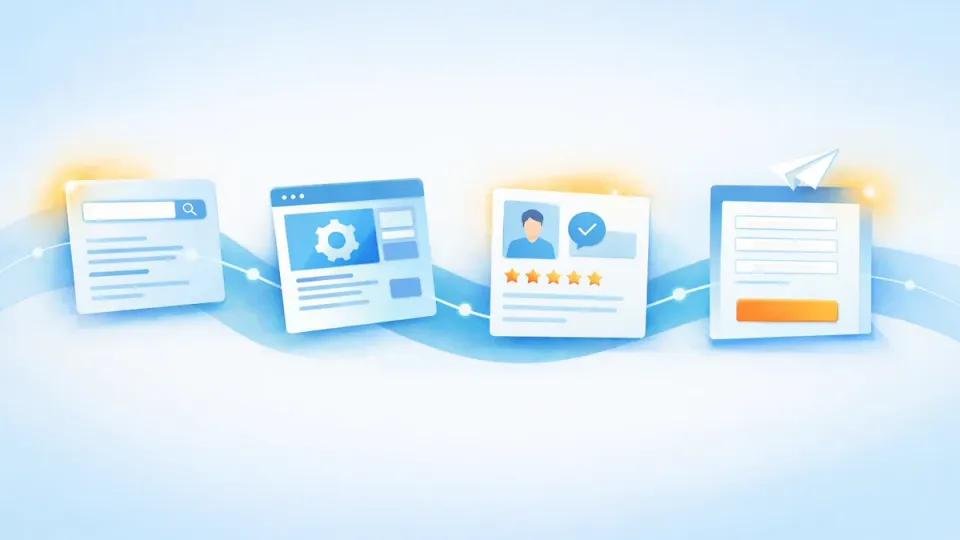
A customer journey describes the path a potential customer takes from the first need to an inquiry, purchase or long-term customer relationship. It includes all touchpoints with a company, such as Google Search, website, blog article, social media, ads, recommendations, emails, initial consultation and offer.
Why is the customer journey important?
Customers rarely decide after a single touchpoint. Especially for services that require explanation, they research, compare providers, check trust, read references and clarify requirements internally. A website therefore has to do more than show a visually appealing homepage.
For web design and conception, the customer journey is important because it helps plan content and user guidance around real decision steps. Someone researching early needs different information than someone ready to submit a concrete project request.
Typical phases of a customer journey
Models vary, but these phases are particularly useful for websites:
| Phase | Typical user question |
|---|---|
| recognizing a problem | What is my problem or goal? |
| informing | Which options exist? |
| comparing | Which providers or solutions fit? |
| deciding | Whom do I trust and what is the next step? |
| using and improving | How does the solution remain successful? |
These phases are not always linear. Users go back, read several pieces of content, return on different devices or become aware again through recommendations and campaigns.
Which touchpoints are part of it?
Digital customer journeys can include many touchpoints:
- organic Google Search,
- FAQ and guide articles,
- service pages,
- references and cases,
- social media content,
- ads and landing pages,
- newsletters,
- review profiles,
- contact form or appointment booking,
- personal conversation.
In online marketing, it is important not to treat these touchpoints in isolation. An ad can create attention, but the website has to build trust. A blog article can explain, but a service page has to enable the next step.
What does customer journey mean for website content?
A good website answers questions along the journey. Early-stage content explains terms, problems and decision options. Service pages show how a provider helps concretely. References prove experience. Contact areas reduce friction.
For lead generation, this means not every visitor is ready for a project form immediately. Some need orientation first. Others are already looking for pricing, process or references. CTAs, internal links and forms should match the situation.
How is a customer journey analyzed?
A customer journey can be understood better through several signals:
- search queries and entry pages,
- click paths on the website,
- common questions from initial calls,
- form drop-offs,
- conversion data,
- CRM information,
- feedback from sales or support.
The important thing is to combine qualitative and quantitative data. Analytics shows what happens. Conversations and inquiries often explain why it happens.
Common planning mistakes
One common mistake is pushing every visitor immediately toward the same inquiry. That can work for simple products, but rarely for more complex services. Another mistake is creating too much content without clear connection. Then information islands appear, but no guidance.
An effective customer journey needs structure: suitable entry pages, clear internal linking, understandable offers and measurable goal actions. It connects content, UX, SEO, campaigns and sales into a coherent path.