
Bajorat Media
What are WebP and AVIF?
WebP and AVIF are modern image formats that can reduce file size and make websites faster.
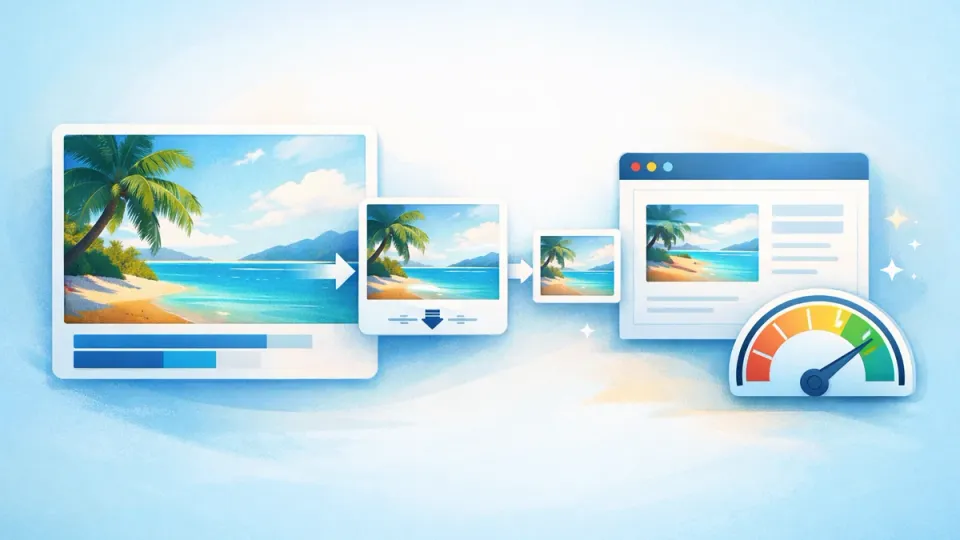
WebP and AVIF are modern image formats for websites. Both can deliver images with much smaller file sizes than classic formats such as JPEG or PNG while maintaining comparable quality. WebP is very widely supported and a stable standard for many websites. AVIF can often compress even more strongly, but may require more encoding time and a suitable fallback strategy.
Why modern image formats matter
Images are among the largest files on many websites. Large hero images, team photos, product images or blog graphics can slow down loading and affect user experience, Core Web Vitals and conversion. Modern image formats are therefore an important part of performance optimization.
The basic idea is simple: if an image looks visually equivalent but requires much less data transfer, the page loads faster. This helps especially on mobile devices, slower connections and pages with many visual elements.
What is WebP?
WebP is an image format that can support lossy and lossless compression, transparency and animation. In practice, WebP is often used as a replacement or supplement for JPEG and PNG. It works well for photos, illustrations, article images and many interface-related graphics.
The MDN overview of image formats describes WebP as a strong choice for images and animations, with much better compression than PNG or JPEG. For website owners, WebP is often the pragmatic first step because browser support and tooling are now mature.
What is AVIF?
AVIF is based on the AV1 codec and is a newer image format. For many motifs, it can produce even smaller files than WebP, especially for complex photos or large visual areas. AVIF also supports modern requirements such as transparency and higher color depth.
The advantage has a practical side: AVIF encoding can be more computationally intensive, and not every editorial workflow is ready for it. For large websites, image CDNs or automated build processes, AVIF is highly interesting. For smaller manual workflows, WebP can sometimes be easier to handle.
WebP or AVIF: which is better?
There is no universal answer. The use case matters:
| Use case | Practical recommendation |
|---|---|
| standard website with editorial images | WebP as a stable default |
| performance-critical pages with image CDN | test AVIF plus WebP/JPEG fallback |
| logos and icons | often SVG instead of WebP or AVIF |
| images with transparency | test WebP or AVIF |
| maximum compatibility | keep fallback to JPEG or PNG |
web.dev notes in its guide to image performance that modern formats such as WebP and AVIF can offer better compression than PNG or JPEG. The concrete image mix remains decisive.
How are WebP and AVIF implemented?
Technically, there are several options. A common approach is the HTML <picture> element, which offers the browser multiple formats. A modern browser can then load AVIF, another browser can load WebP, and an older browser can fall back to JPEG or PNG.
In modern static site setups, WordPress build processes or image CDNs, this delivery can be automated. The format alone is not enough. Image dimensions, srcset, lazy loading, caching and sensible quality settings are also part of image optimization.
What does this mean for SEO?
WebP and AVIF are not direct ranking tricks. They help indirectly because smaller images can improve loading speed, user experience and metrics such as Largest Contentful Paint. If the largest visible element of a page is an oversized image, the image format can make a noticeable difference.
The practical recommendation for website owners is: do not only convert images, deliver them systematically. The best format does little if a 4000-pixel-wide image is sent unnecessarily to a smartphone. WebP and AVIF are powerful tools, but they work best as part of a thought-through image and performance concept.