
Bajorat Media
What is a Sales Funnel?
A sales funnel maps the path from initial awareness to purchase. Learn how its stages work and how companies can improve conversion rates.
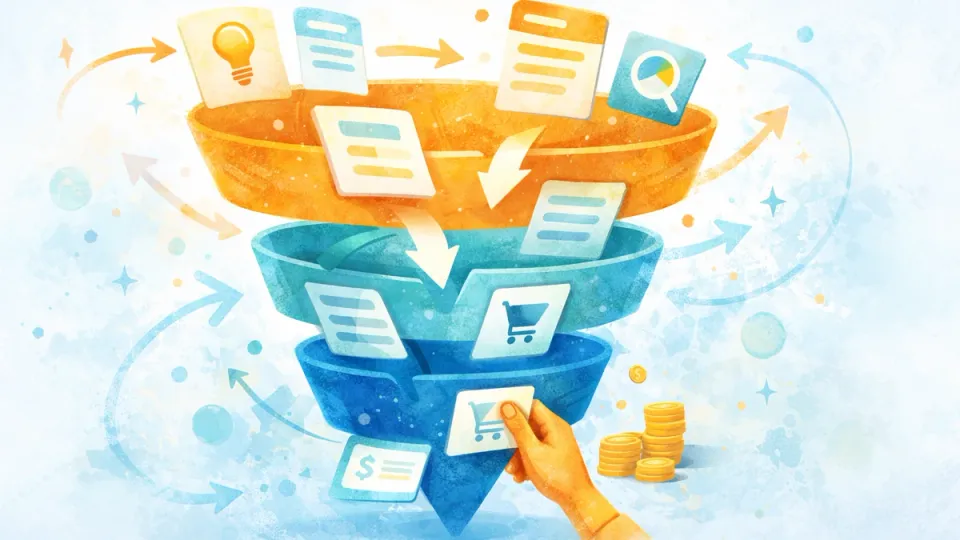
A sales funnel maps the path a potential customer takes from the first contact with a company to a purchase or booking. The funnel metaphor describes how a broad audience at the beginning becomes a smaller group of interested prospects and, eventually, paying customers.
Companies use this model to understand customer decisions, plan marketing and sales activities, and identify where prospects abandon the journey. The funnel is therefore both a visualization and an analytical tool.
Which stages make up a sales funnel?
There is no mandatory number of stages. A compact model uses awareness, interest, decision and action. A more detailed version separates evaluation from commitment and therefore has five stages. Both approaches describe the same customer journey at different levels of detail.
1. Awareness
The potential customer first becomes aware of a company, product or service. Search engine optimization, paid search advertising, social media, recommendations and other campaigns can generate this initial contact. The relevant metric is not reach alone, but how many people from the intended target group enter the funnel.
2. Interest
The prospect begins to research the offer and its benefits. Website visits, repeated contact with content, subscribing to email updates or interacting with the company on social networks can indicate growing interest. At this stage, product information, service descriptions, examples and answers to common questions help prospects decide whether the offer fits their needs.
3. Evaluation and decision
Prospects compare the offer with alternatives, examine prices and assess whether the expected benefit justifies the investment. Useful content should address selection criteria and likely objections. A professional website, product demonstrations, case studies or webinars can support this comparison.
In a four-stage funnel, evaluation and commitment are usually combined as the decision stage. In the five-stage model, commitment is treated separately: the prospect has selected the preferred offer but may still need internal approval, a concrete proposal or reassurance before proceeding.
4. Commitment
The prospect is ready to buy the product or commission the service. The task at this point is to remove avoidable barriers. Clear terms, credible trust signals, an understandable proposal and direct answers to remaining questions can make the decision easier. Depending on the offer, trials, discounts or relevant bonus services may provide an additional incentive.
5. Purchase or action
The final stage covers the actual purchase, payment, booking or signed contract. Forms, checkout pages and payment methods should support the decision instead of creating new friction. An unnecessarily long checkout, missing payment options or unclear next steps can still cause abandonment at this late point.
How can a sales funnel be optimized?
Optimization starts by measuring the transitions between stages. If many people see a campaign but few visit the website, targeting or the message may be the problem. If prospects reach a product page but do not inquire or buy, the offer, evidence, usability or purchasing process needs closer examination.
Common optimization methods include:
- Split testing: Compare page variants, calls to action, forms or checkout steps to learn which version reduces abandonment.
- Content and offer refinement: Answer the questions that arise during interest and evaluation, and present benefits in a form that supports comparison.
- Remarketing: Reach prospects again when they have shown interest but have not completed the desired action.
- Email marketing: Provide relevant follow-up information and maintain the customer relationship after an inquiry or purchase.
- Checkout and process improvements: Remove unnecessary fields, explain the next step and offer suitable payment or contact options.
The goal is not to push every contact toward a purchase. A useful sales funnel helps the right prospects reach a well-founded decision and shows the company where its acquisition and retention process can be improved. Better transitions between stages can increase the conversion rate and contribute to higher sales.