
Bajorat Media
The True Origin of Lorem Ipsum: History, Meaning, and Uses in Design
Lorem Ipsum explained clearly: origin, history, meaning, risks and best practices for design, typography and web projects.
Anyone who deals with web design, graphic design, typography or layout design will sooner or later come across the same strange-looking text: “Lorem ipsum dolor sit amet…”. This dummy text has become a silent standard – in design tools, content management systems, theme demos, UI kits and even print templates. At first glance it seems like meaningless gibberish that only serves to fill empty spaces. But behind “Lorem Ipsum” there is a longer and much more exciting story than many people assume. The ubiquity of this placeholder text is no coincidence. “Lorem Ipsum” fulfills a very specific typographic and design function: It allows layouts to be tested realistically without real content obscuring the view of structure, readability and visual hierarchy. Especially in times of Responsive web design, complex design systems and headless CMS, it is more important than ever to work with texts that behave like real content - in length, rhythm and character appearance. At the same time, the use of Lorem Ipsum raises questions: Where does this text actually come from? What did it originally mean? What risks arise if blind texts are carelessly included in prototypes, product demos or even live systems? And what alternatives are there if you need accessible, SEO-friendly and culturally sensitive solutions? This article answers these questions in detail and shows you how to use Lorem Ipsum professionally, sensibly and responsibly. To understand the role of Lorem Ipsum today, it is worth taking a look at history - back to antiquity, through the Renaissance and traditional typesetting to the digital present. Only the interplay of historical origin, typographic function and modern practice explains why this seemingly random Latin text could become the global standard for blind texts.
The True Origin of “Lorem Ipsum”: History, Meaning and Applications
Avoid distraction: Why real text distorts the layout
In the practice of graphic and web design, the same phenomenon occurs again and again: As soon as a layout is filled with real, content-relevant text, the focus shifts. Instead of evaluating the grid, typography, white space or readability, the team starts discussing wording, content corrections or technical details. This so-called “content bias” leads to important design decisions being made too late or under false premises. Blind text like “Lorem Ipsum” is intended to avoid exactly this distraction. They provide a text structure that looks and behaves like real continuous text - with words of different lengths, punctuation marks, sentence rhythm and typical syllable sequences - without readers being able to deal with the content. The layout can be assessed neutrally: How does the font size work? Is the line length comfortable? Does reading flow work across multiple columns? Are the proportions and spacing correct? This is particularly advantageous for presentations to customers or stakeholders. A prototype with Lorem Ipsum forces the audience to focus on the design. Only in a later phase, when design guidelines and structures are in place, does the real content come to the fore. In this way, you consciously separate the phases of information architecture, visual design and content creation from each other. Lorem Ipsum also helps save time in agile product teams or rapid prototyping processes. Instead of waiting a long time for the final text, designers and developers can test working designs early on. Usability tests for interaction design or information hierarchy are already possible while text and subject matter experts are still working on the final content.
Placeholders vs. real content: Typographic and semantic requirements
Dummy text is much more than “just any letters”. For placeholder text to truly serve its purpose, it must meet both typographic and semantic requirements. Typographically, it is important that the text represents realistic word and sentence lengths and imitates the expected typeface in the later product. Words that are too short, atypical character strings, or missing punctuation lead to a distorted image: lines wrap differently, columns appear unbalanced, and the reading rhythm is not realistically simulated. Semantically, blind text should be deliberately incomprehensible in order to prevent readers from unintentionally interpreting substantive statements. Lorem Ipsum is therefore written in an outdated, fragmented Latin form that is neither intuitive nor fully understandable to most people. It is precisely this “semi-intelligibility” that ensures that the eye perceives the structure of the text – lines, paragraphs, boldfaces, lists – without getting lost in the content. At the same time, the text must appear “neutral” and not convey any cultural or political connotations that could unconsciously influence test results or design decisions. This also shows why a historical, non-everyday text like Lorem Ipsum has become established in everyday design: it carries comparatively little current significance with it. However, classic blind text and especially Lorem Ipsum reach their limits where typographic diversity, linguistic diversity and multilingualism are relevant. Differences between languages - such as word lengths in German, syllable structures in French, use of umlauts or special characters - can only be simulated to a limited extent with purely Latin blind text. Professional teams take this into account by using language variants and customized placeholder text.
Risks of blind text: misunderstandings, accessibility and SEO traps
As useful as Lorem Ipsum is in the design process, unreflective use can cause problems. A common risk is that dummy text is accidentally left in live systems: such as published web pages, app store screenshots, printed materials, or product demos. Not only does this appear unprofessional, but it can also undermine trust and raise questions about a company’s care and competence. Another critical aspect is accessibility. Screen readers and other assistive technologies attempt to interpret dummy text in the same way as real content. A user who has a page read to them will then experience a series of incomprehensible Latin fragments that offer no added value and make orientation difficult. If additional measures such as ARIA attributes, placeholder labels or replacing alternative texts are missing, the accessibility of the entire page suffers. In the context of search engine optimization (SEO), blind texts can lead to significant disadvantages. Pages that are still “under construction” or are mistakenly indexed with Lorem Ipsum send the signal to search engines: There is no relevant content here. This affects visibility, relevance ratings and possibly the perception of the entire domain. This is particularly tricky for landing pages, microsites or product pages that go live early and are only filled later. Last but not least, blindly adopted Lorem Ipsum also entails organizational risks. If teams do not clearly mark placeholders - for example through colored backgrounds, comments in the code or tickets in the project management tool - it can easily be overlooked in the hectic day-to-day work of a project which elements still need to be revised. A structured approach with clearly defined handover points between design, editing and development significantly reduces this risk.
Origin & History of “Lorem Ipsum”

Ancient Roots: Cicero, Classical Texts and the Earliest Fragments
Surprisingly to many, the origins of Lorem Ipsum lie in a genuine ancient text. Core passages come from a writing by the Roman philosopher and politician Marcus Tullius Cicero, more precisely from “De finibus bonorum et malorum” (“On the Limits of Good and Evil”), written in the 1st century BC. This philosophical dialogue deals with the nature of the good and the questions of ethics in the context of various philosophical schools. The most famous standard version of Lorem Ipsum begins “Lorem ipsum dolor sit amet, consectetur adipiscing elit…”. If one reconstructs the original source, one finds a similar sentence in the Cicero text: “Neque porro quisquam est qui dolorem ipsum quia dolor sit amet, consectetur, adipisci velit…”. However, today’s Lorem Ipsum is a combination of mutilations, conversions and additions. Over centuries, the text was typographically adapted, shortened and adapted to new layout needs until the fragments we use today emerged. Interestingly, Cicero’s work was not intended as a dummy text, but as a serious philosophical treatise in well-written Latin. It was only much later that typesetters began to use individual passages as neutral text because they were of sufficient length and typographic variety. As Latin became less and less understood in everyday life, the effect of “loss of meaning” increased - an ideal breeding ground for use as pseudo-neutral filler text. Historical studies, for example by the researcher Richard McClintock in the 1980s, have systematically traced the trail of Lorem Ipsum. Old type specimen books, print samples and typesetting manuals were analyzed. This work showed that Lorem Ipsum is by no means pure random text, but rather goes back to concrete passages from well-known ancient works - albeit in a highly distorted form.
Renaissance to modernity: How fragments became a standard
With the invention of printing by Johannes Gutenberg and the spread of lead type in the Renaissance, a need for sample pages, font samples and layout examples arose. Typesetters needed texts with which they could illustrate new fonts, type areas and columns. Classical Latin authors were often used - not least because Latin was already a language of scholarship and education back then. Over time, the function of these texts changed. What was initially set as a more or less coherent, understandable text increasingly became pure material for typographic experiments. Sentences were shortened, reassembled, spiced up with additional words or capped endings to create specific line lengths or word images. In this way the original meaning began to be lost while the form was retained. Lorem Ipsum developed into a kind of “typesetting tradition” at the latest in the 19th and early 20th centuries. Sample books from various printers show similar, although not identical, versions. As with stories passed down orally, variations were introduced when they were copied or rewritten, which then spread themselves again. This is how variants and local “dialects” of Lorem Ipsum emerged - with slightly different word sequences, additions or omissions. This process explains why it is not possible today to create an exact 1:1 correspondence between standard Lorem Ipsum and the original Cicero text. Rather, it is a historically grown conglomerate that has repeatedly adapted to technical and design needs. This is precisely what makes the story of Lorem Ipsum an interesting example of how technical practice can transform fragments of literature across centuries.
From typesetting to desktop publishing: Distribution in printing
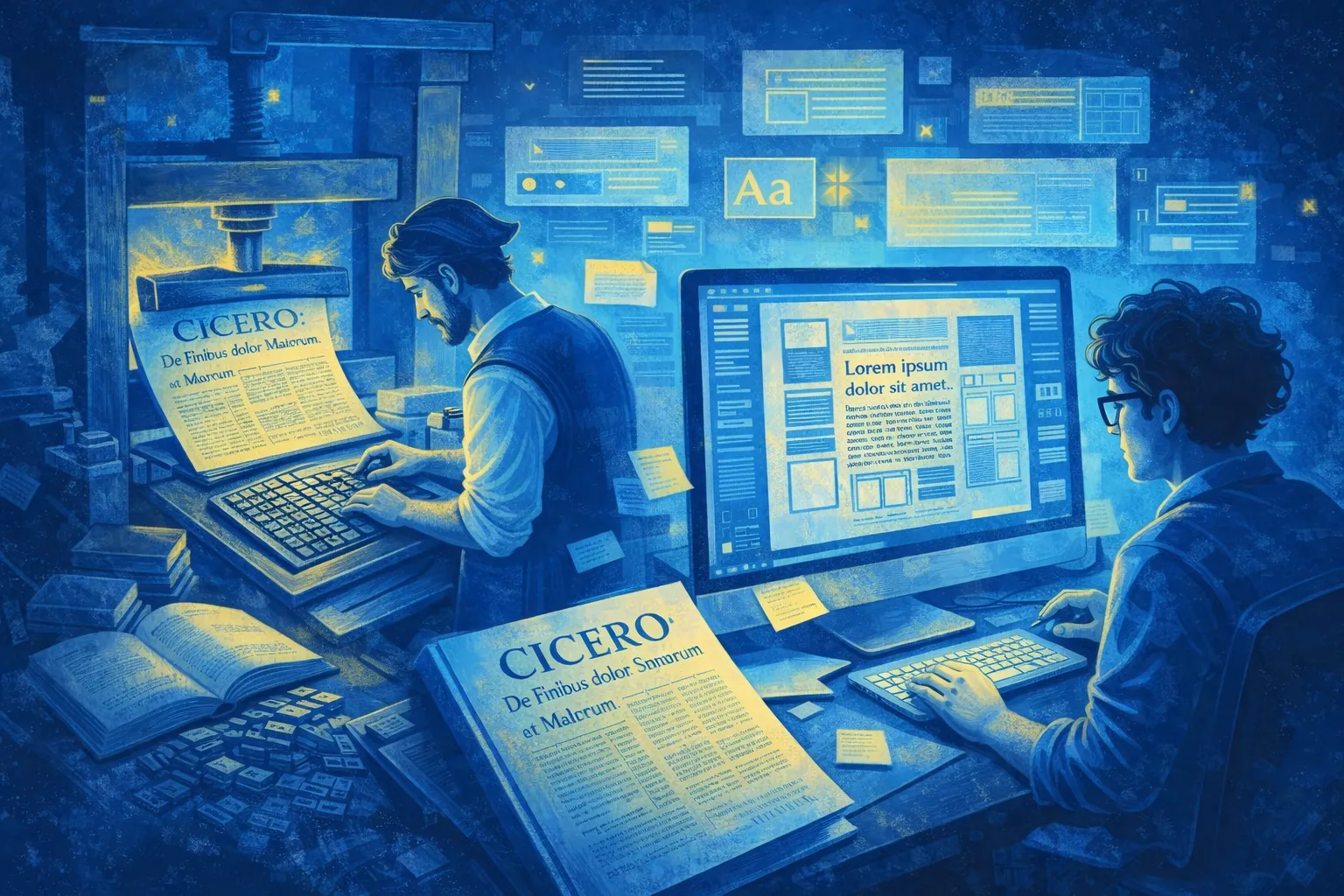
With the advent of modern typesetting machines and later phototypesetting, the handling of placeholder texts became more professional. Typewriters kept standardized dummy texts available to show early drafts to customers or to create internal test layouts. By this time, Lorem Ipsum had already become established in many European printing companies, although not necessarily under this name. People spoke more generally of “dummy text” or “filler text”. A key step towards today’s ubiquity occurred in the 1960s and 1970s, when Lorem Ipsum appeared in typographic specimen books produced by a well-known typewriter. These patterns were distributed worldwide and used as a reference by designers and printers. Anyone who worked with certain standard fonts automatically came across the same dummy text. This is how Lorem Ipsum spread through the typography industry. With the triumph of desktop publishing in the 1980s – through programs such as Aldus PageMaker, later Adobe PageMaker and InDesign – Lorem Ipsum finally migrated into the digital world. Many of these programs included built-in Lorem Ipsum functions or examples. Designers could fill entire pages with dummy text with just a few clicks, simulating layouts for brochures, magazines and books. This development marks a turning point: a technical tool of the printing industry became a component of the general design and media culture. With the increasing popularity of personal computers, layout software and later web editors, Lorem Ipsum became available to an ever larger group of users - including hobby webmasters, bloggers and students.
Digital Age: Generators, Content Management Systems and Web Design
In the digital age, Lorem Ipsum has experienced a new wave of popularity. With the advent of early web design, developers and designers looked for quick methods to test page structures. The first online Lorem Ipsum generators emerged early on, generating paragraphs, lists or headings at the push of a button. Today there are countless variations - from classic Lorem Ipsum to thematic variations (“Hipster Ipsum”, “Bacon Ipsum”, “Corporate Ipsum” and many others). Content management systems (CMS) like WordPress, Drupal or TYPO3 as well as static site generators and UI component libraries often come with their own demos that contain Lorem Ipsum. Frontend frameworks such as Bootstrap, Foundation or Tailwind ecosystems use dummy text in example components to simplify development and learning processes. Lorem Ipsum also became an educational tool for aspiring web developers. At the same time, there was a growing awareness that pure Lorem Ipsum cannot cover all use cases. Responsive design, complex navigation structures and content strategy require more realistic texts - at least in later project phases. Therefore, modern workflows often combine classic Lorem Ipsum paragraphs with specific content scenarios, user stories and targeted test texts. Lorem Ipsum can now also be generated automatically in design tools such as Figma, Sketch or Adobe XD using plugins and integrated functions. Interfaces also make it possible to integrate mock data from APIs or headless CMS. Lorem Ipsum remains a basic tool, but is increasingly embedded in data-driven, dynamic prototyping approaches.
Content & Analysis: What is actually in “Lorem Ipsum”?
Latin fragments, meaningful words or meaningless letters?
At first glance, Lorem Ipsum seems like random combinations of letters. However, upon closer inspection, one can see that many words are clearly identifiable as Latin terms: dolor (pain), amet (form of “amare” – to love), consectetur (to “consequi” – to achieve), adipiscing (to “adipisci” – to obtain), and others. The text is therefore not a pure fantasy product, but is based on real words, albeit in a mixed and sometimes distorted form. The original Cicero passage that Lorem Ipsum refers to has to do with the rejection of pain for the sake of pain. However, the Lorem Ipsum variants commonly used today largely lose this connection. The grammatical structure breaks down through cuts, word rearrangements and additions. Individual groups of words can still be translated sensibly, but the overall text no longer forms a consistent, understandable context. This mixture of recognizable Latin and incomplete grammar creates exactly the peculiar effect that characterizes Lorem Ipsum: the text appears “linguistically plausible” without being actually readable. You can recognize the beginnings of sentences, subordinate clauses, insertions - but the brain cannot construct clear content. This means the focus remains on the visual effect of the words, not on their content meaning. From a linguistic point of view, Lorem Ipsum is an interesting artifact: a semi-intermediate state between meaningful language and a pure mixture of characters. This intermediate form is ideal for typography and layout - it shows structure without attracting attention.
Why text works well for typography and layout
The strength of Lorem Ipsum lies in its typographical quality. The text contains a balanced mix of short and long words, different syllable structures and punctuation marks. This creates a comparatively “natural” running pattern that is similar to that of many modern languages. Spacing, line breaks, justified behavior and hyphenation can be easily tested with this. Lorem Ipsum also avoids some of the common pitfalls of other placeholder text. Pure repetitions (e.g. “Text Text Text…”) or artificial patterns (such as ABC sequences) create a monotonous typeface that rarely occurs in practice. You can incorrectly attribute a font as too high or too low in readability. The heterogeneous word image of Lorem Ipsum, on the other hand, more closely reflects real reading situations - especially in longer continuous texts. Lorem Ipsum also has an advantage over placeholders in modern languages - such as randomly drawn German or English sentences: although it has a linguistic effect, it remains largely neutral in terms of tonality, culture, gender, role models or political content. Anyone who uses random newspaper articles or social media posts in the prototype instead of Lorem Ipsum runs the risk of unintentionally reproducing stereotypes or controversial content. At the same time, the text is short and concise enough to be implemented in many design tools. Standard snippets like the first paragraph of Lorem Ipsum fit into almost any text box and can be quickly duplicated. This also resulted in a practical convention: Many designers recognize from the first word “Lorem” that they are placeholders – an informal but effective signal in everyday work.
Practical instructions: How to use “Lorem Ipsum” correctly and sensibly
Tools and Generators: Recommendations for Designers and Developers
Anyone who wants to use Lorem Ipsum professionally in the design or development process benefits from specialized tools. Numerous online generators allow you to create individual amounts of text - from a few words to several paragraphs to page fillers. Many offer options for case sensitivity, HTML tag integration, or different variations of dummy text. Browser extensions and editor plugins are particularly helpful for web developers. In code editors like Visual Studio Code, Sublime Text or JetBrains-IDE, there are shortcuts like lorem that automatically expand into a paragraph of Lorem Ipsum. Design tools like Figma or Sketch have plugins that insert dummy text directly into selected text boxes. In content management systems, dummy content can be delivered via seed scripts, demo datasets, or built-in fixtures. It is worthwhile to manage the dummy text centrally instead of copying and distributing it manually. This makes it easier to see which content needs to be replaced with real content later. It is important to use it consciously: Use Lorem Ipsum especially in the early design and prototyping phases. In later stages - especially in usability testing and shortly before launch - real or realistically simulated content should be used if possible to reflect actual usage scenarios.
Best practices: length, language variants and adaptation to the project
A common mistake is to always use the same short standard paragraph. For a realistic simulation, text lengths should vary: short teasers, medium-length introductory texts, long specialist articles. This helps test layout limits: what happens if a title becomes very long? Does a menu break into two lines? Does readability remain with 20 lines of continuous text? For multilingual projects, it is recommended to adapt Lorem Ipsum linguistically. Although Latin remains useful as a basic text, differences in word lengths and character sets between different languages cannot be fully captured. For German layouts, additional dummy text with umlauts and typical compound nouns can be helpful (“tram ticket machine”) to test line breaks and hyphenation. The semantic structure should also be taken into account at an early stage: headings, subheadings, lists, quotes, captions, buttons and forms require different types of text. Instead of using the same dummy text everywhere, it makes sense to define format- or component-specific patterns. A call-to-action button only needs two to three words, a tool tip a short sentence, a product description several paragraphs. Last but not least, dummy texts should be clearly marked in the project - for example through internal comments, special CSS classes or notes in the design system. This will prevent Lorem Ipsum from accidentally remaining in the final product. A simple but effective method is to build in automated checks before go-live that look for occurrences of “lorem” or specific dummy text fragments.
Alternatives to Lorem Ipsum: Realistic placeholder text and localized solutions
In many situations, classic Lorem Ipsum is sufficient - especially for generic layout tests. However, there are scenarios where more realistic placeholder text makes sense. These include, for example, usability tests with real users in which content plays a central role, or products with a strongly text-related function, such as news portals, blogs or specialist magazines. An alternative are “real content simulations”: texts that are similar to the later content in structure, tonality and complexity, but do not contain any sensitive information. These can be created manually or generated semi-automatically from existing content and anonymized. In this way, readability, scannability and information architecture can be tested realistically. Localized blind texts are becoming increasingly important for internationally oriented projects. Special generators offer variants in different writing systems - from Cyrillic to Greek to non-Latin scripts such as Arabic or Japanese. These help to assess font support, line heights, font mixes and language-specific typography better than pure Latin. There are also thematic blind texts, for example for gastronomic, technical or legal contexts. They use realistic-sounding technical terms without conveying specific content. Such texts can be particularly useful if the target group is highly technical and the language of the product is an essential part of the user experience.
Legal & Ethics: When to be careful
Copyright, trademark and cultural aspects
From a purely legal perspective, Lorem Ipsum in its current form is generally unproblematic. The original text by Cicero has long been in the public domain under copyright law because the term of protection has long been exceeded. The widely modified version of the dummy text has also been in general use for decades and is not exclusively protected. However, certain legal and ethical aspects should not be ignored. It can become problematic if other, non-license-free content is used as placeholders instead of Lorem Ipsum - such as excerpts from current articles, books or websites without the consent of the rights holder. Such texts are quickly copied in prototypes and can unintentionally appear in presentations, public portfolio works or live demos. In an emergency, there is a risk of copyright infringement. Trademark risks also need to be taken into account if logos, product names or slogans of real companies are used as dummy content. A demo website with an invented “example company” is not a problem if the name and appearance do not imitate a real brand. However, anyone who reproduces well-known brands without consent could violate trademark rights or give the impression of non-existent cooperation. Ultimately, cultural and ethical considerations play a role. Thematic blind texts that contain stereotypical group descriptions, political content or potentially discriminatory language should be avoided - even if they are only used prototypically. Design work shapes thinking and decision-making processes; Anyone who consciously acts sensitively here lays a foundation for responsibly designed products.
Conclusion: Origin understood – when and how to use “Lorem Ipsum” sensibly
“Lorem Ipsum” is much more than just curious standard text in design tools. Its roots go back to Roman antiquity, its journey leads through Renaissance typesetting, industrial typography and desktop publishing to today’s world of web design, apps and digital products. It is precisely because it is based on real, albeit heavily modified, Latin fragments that it is so suitable as a neutral blind text. For designers, developers, editors, and product teams, Lorem Ipsum is a handy tool for testing layouts, making typographic decisions, and creating prototypes without being distracted by substantive discussions. At the same time, it has been shown that unreflective use carries risks - from accessibility problems to SEO disadvantages to organizational errors when blind text remains in finished products. The key therefore lies in conscious, context-sensitive use. Lorem Ipsum remains a proven standard in early project phases and for abstract layout questions. The closer a project comes to real use, the more real or realistic content should be incorporated, ideally in several language and scenario variants. In addition, clear labels and automatic checking mechanisms make sense to avoid accidental takeovers. Anyone who understands the origins, function and limitations of Lorem Ipsum can use it specifically and professionally - as a useful tool in the design toolbox, not as a convenient permanent solution to all content issues. This creates a design process that is both typographically sound and responsible in terms of content.
Conclusion: Further sources, reading tips and recommended references
If you want to delve deeper into the world of Lorem Ipsum, typography and blind texts, you will find a number of exciting sources and tools. Readers interested in history can consult Cicero’s original texts, in particular “De finibus bonorum et malorum”, which is available online in various Latin and translated versions. Richard McClintock’s research into the origins of Lorem Ipsum provides additional insights into the philological background. Practically oriented designers benefit from specialist books on typography and editorial design, which deal with the use of blind text in the context of type area, font choice and reading guidance. Standard works on micro and macro typography shed light on how dummy texts help to optimize line spacing, column widths and hierarchies - and when the transition to real content should take place. Tested online generators and plugins that offer not only classic Lorem Ipsum but also language- and domain-specific variants are worthwhile for everyday work. Tools that can output HTML structures, Markdown or JSON are useful in order to be seamlessly integrated into development workflows. Anyone working with accessible products should also consult resources on accessible design, WAI-ARIA and content strategy in order to use blind text responsibly. Last but not least, it is worth taking a regular look at current specialist blogs and conference presentations on UX, content design and information architecture. New methods are presented here on how realistic test data, localized placeholder texts and content strategy approaches can be interlinked. Lorem Ipsum remains a useful starting point - but not the destination. What is crucial is how well it succeeds in making the transition from formal design to products that are convincing, understandable and barrier-free in terms of content.